EU’s top leaders arrive in Delhi, receive ceremonial welcome ahead of Republic Day visit
European Council President António Costa and European Commission President Ursula von der Leyen arrived in New Delhi on Sunday, January 25, 2026, receiving a ceremonial welcome and Guard of Honour as they begin a state visit timed with India’s Republic Day celebrations. Their presence as chief guests is being read as a signal of a closer India–EU strategic partnership, with trade and geopolitical coordination expected to feature prominently in discussions.
A high-profile EU delegation lands in New Delhi
On Sunday, January 25, 2026, European Council President António Costa and European Commission President Ursula von der Leyen were accorded a ceremonial welcome and Guard of Honour in New Delhi as they commenced a state visit to India. The visit, which runs through the Republic Day period, has attracted attention because it brings the EU’s top institutional leadership into the Republic Day spotlight together.
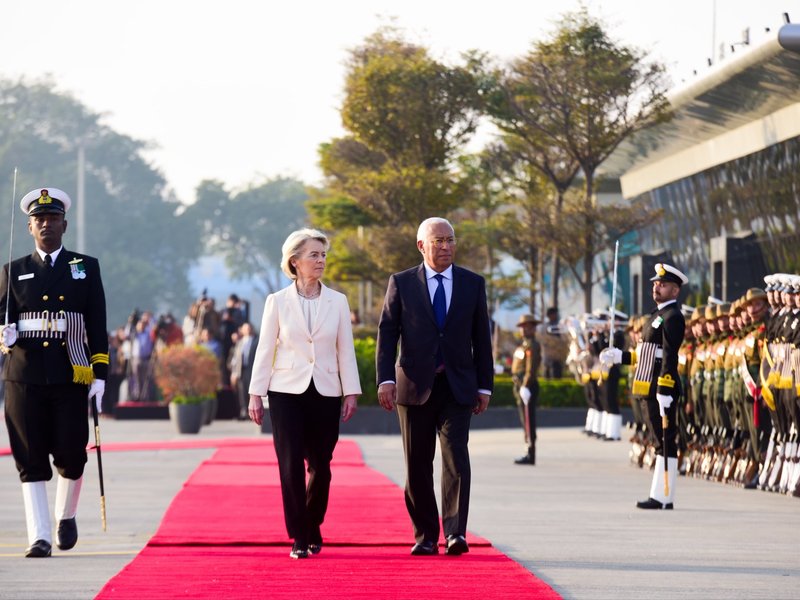
Officials described the arrival as part of a broader diplomatic engagement that aligns symbolism with substance: the Republic Day stage provides visibility, while the state-visit format creates room for extended talks on trade, technology cooperation and global issues where India and Europe increasingly find shared interests.
Why this visit matters beyond ceremony
Beyond the formalities, the visit is being framed as an affirmation of India–EU ties at a time when both sides are seeking reliable partnerships across supply chains, technology and strategic stability. The EU’s leadership arriving together also projects the bloc as a consolidated partner, rather than a set of bilateral tracks with individual member states.
In India, such invitations are routinely viewed as carefully calibrated diplomatic signals. By bringing the European Council and Commission presidents as chief guests, New Delhi highlights its intent to elevate engagement with the EU as an institution—especially as the two sides manage overlapping priorities on trade, investment, climate and emerging technologies.
The immediate agenda: meetings, messaging and next steps
While the ceremonial welcome sets the tone, the substantive calendar typically revolves around meetings with senior Indian leadership and inter-departmental engagements aimed at converting political intent into workable roadmaps. The timing—January 25, just ahead of the Republic Day parade on January 26—also allows both sides to use the global media window to communicate shared positions on major international issues.
For observers, the key question is how far this elevated political signalling translates into measurable outcomes on trade, standards and technology cooperation—areas where India and the EU have strong complementarities but also historically complex negotiations.